
Fatal bird strikes on power lines are a persistent and preventable problem, especially for migratory species unfamiliar with the terrain. These strikes and deaths have real consequences for wildlife and utility operations, leading to preventable deaths, customer outages, damaged equipment, and regulatory risk.
That’s why bird diverters are necessary for safe utility operations, and the research proves it. Studies from Hawaii, the US, and Europe consistently find that bird flight diverters reduce bird mortality. When a transmission line in western Belgium was fitted with FireFly FF markers, researchers counted 30 carcasses in 2001 and 113 in 2018 before marking, and 6 in 2021 after it. Collisions fell by at least 85 percent and mortality by at least 73 percent, with some species groups at zero.
The remaining challenge is not whether diverters work, but how to install them safely, quickly, and cost-effectively. Here is where drone technology is solving that problem for utilities across the U.S. and internationally.
First, Understanding the Limits of Traditional Installation
Historically, bucket trucks, lineworkers climbing poles, and helicopters have been the go-to methods for bird diverter installation. Each method has significant drawbacks.
Bucket trucks require road access, which is often impossible in wetlands, canyons, or protected habitats without building temporary access roads. Helicopters avoid that requirement but are expensive, weather-dependent, and carry high operational and safety risk. Traditional installation also puts lineworkers at height and close to live lines, increasing the risk of injury.
The Efficiency of Drone Installs
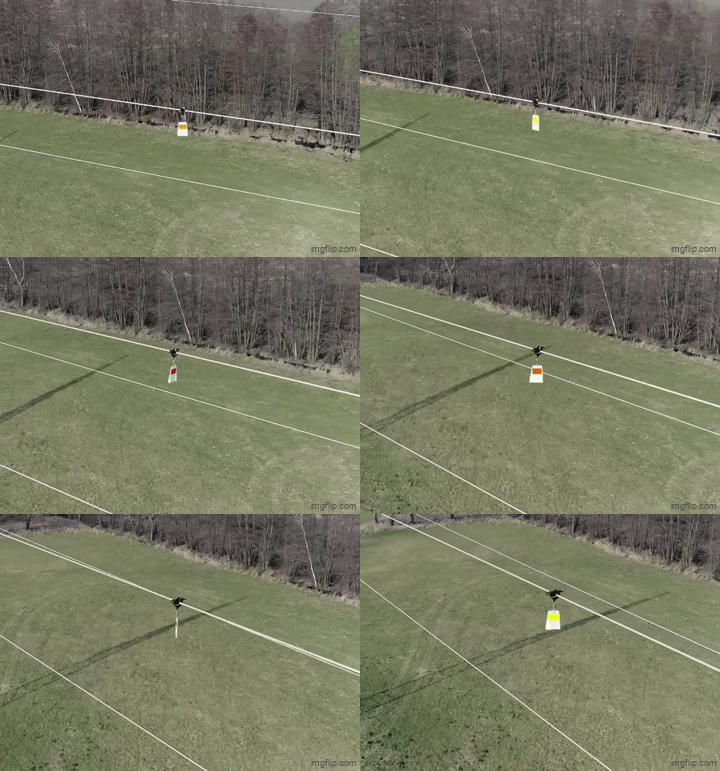
Drone-deployed diverter installation removes workers from the danger zone entirely and dramatically improves productivity. Modern utility drone platforms can be fitted with specialized diverter mount systems, allowing crews to carry, position, and secure devices directly on energized or de-energized lines without physical contact.
On the High Banks Wind project in Kansas, the contractor used a drone system to place close to 15,000 diverters along 75 miles of new 345 kV line.
Drones can also survey power lines and also support maintenance, which utilities are rapidly adopting as part of comprehensive reliability programs.
What Utilities Gain from Drone Installation
Safety First. Removing crews from heights and proximity to live wire reduces risk. When Ameren Missouri marked a crossing at the Lake of the Ozarks in October 2022, it put 300 diverters on a 345 kV line by drone and described the method as the safest and most reliable option it had compared with a helicopter.
Speed and Efficiency. Drones can access spans in rugged terrain, including forests or wetland buffers where bucket trucks cannot go. Many utilities have used this approach to complete installation work much faster and with fewer mobilizations.
Cost Savings. Helicopter day rates and mobilization are the line items a drone crew removes; the diverters cost the same either way. NRECA’s report on Kauaʻi’s program found that UAV-supported line marking can reduce cost and improve safety against helicopter and bucket-truck work.
Remote Access and Scalability. Drones can reach miles of line without disturbing ground access, which is especially valuable in environmentally sensitive or inaccessible areas.
Drone installation also complements other utility safety and compliance efforts, such as power line markers that alert pilots, helicopter crews, and other aerial operators to obstacles.
What the Research Says About Diverters
Two field studies are worth knowing by name, because both get cited loosely. In southern Spain, Ferrer and colleagues marked 133 spans across three 400 kV lines with three diverter types and counted carcasses against unmarked spans: 131 dead birds from 32 species. Flappers cut the mean mortality rate by 70.2 percent, with a 95 percent confidence interval of 50 to 90. Orange spirals managed 43.7 percent and yellow spirals 40.4 percent, each with an interval wide enough to include almost no effect at all. The flapper result held across conditions. The spiral results did not.
The Belgian figures above come from Verbelen, Bovens, Dwyer and Swinnen, who marked a transmission line with FireFly FF markers and compared eleven carcass surveys in each of 2001, 2018 and 2021. Depending on species group and which earlier year you compare against, collisions fell by at least 85 percent and in some cases to zero. FireFly is a flapper. It swings on its bearing, reflects daylight and glows after dark, so the Spanish result is a result for its class of device and the Belgian one is a result for the product itself.
Measurable Wildlife Protection
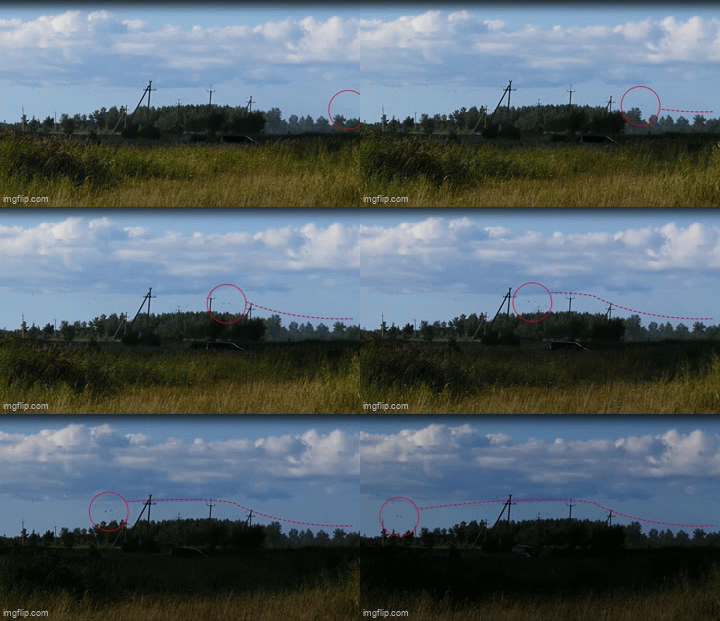
The ecological impact of correctly installed bird diverters is well documented. Kauaʻi Island Utility Cooperative began drone installs around 2020 with a plan for tens of thousands of diverters across 740 spans, to protect three endangered seabird species and five threatened or endangered waterbirds. In December 2025 Hawaiian Electric ran three weeks of drone installs on Maui, on lines that Hawaiian petrels and Newell’s shearwaters cross between their mountain colonies and the ocean, without taking the lines out of service.
Broader Integration with Utility Safety Programs
Drones for aerial workflows don’t just serve bird diverter installation. Utilities are exploring them for a wide range of applications, from vegetation encroachment surveys to asset inspection and maintenance planning. As these drone programs mature, they become part of an integrated utility reliability strategy that increases safety and reduces risk across operations.
Drone deployment also aligns with other utility safety products such as low line warning systems and signage, which enhance visual awareness for field teams and aerial operators alike.
The Bottom Line
Drone-deployed bird diverter installation is no longer experimental. It is a proven operational approach that delivers measurable safety, cost, and ecological benefits. For utilities balancing reliability goals, worker safety, and environmental standards, drones offer a smarter way forward.
By adopting these technologies alongside products like power line markers and targeted warning systems, utilities are building more resilient networks that serve both people and wildlife better than ever.