
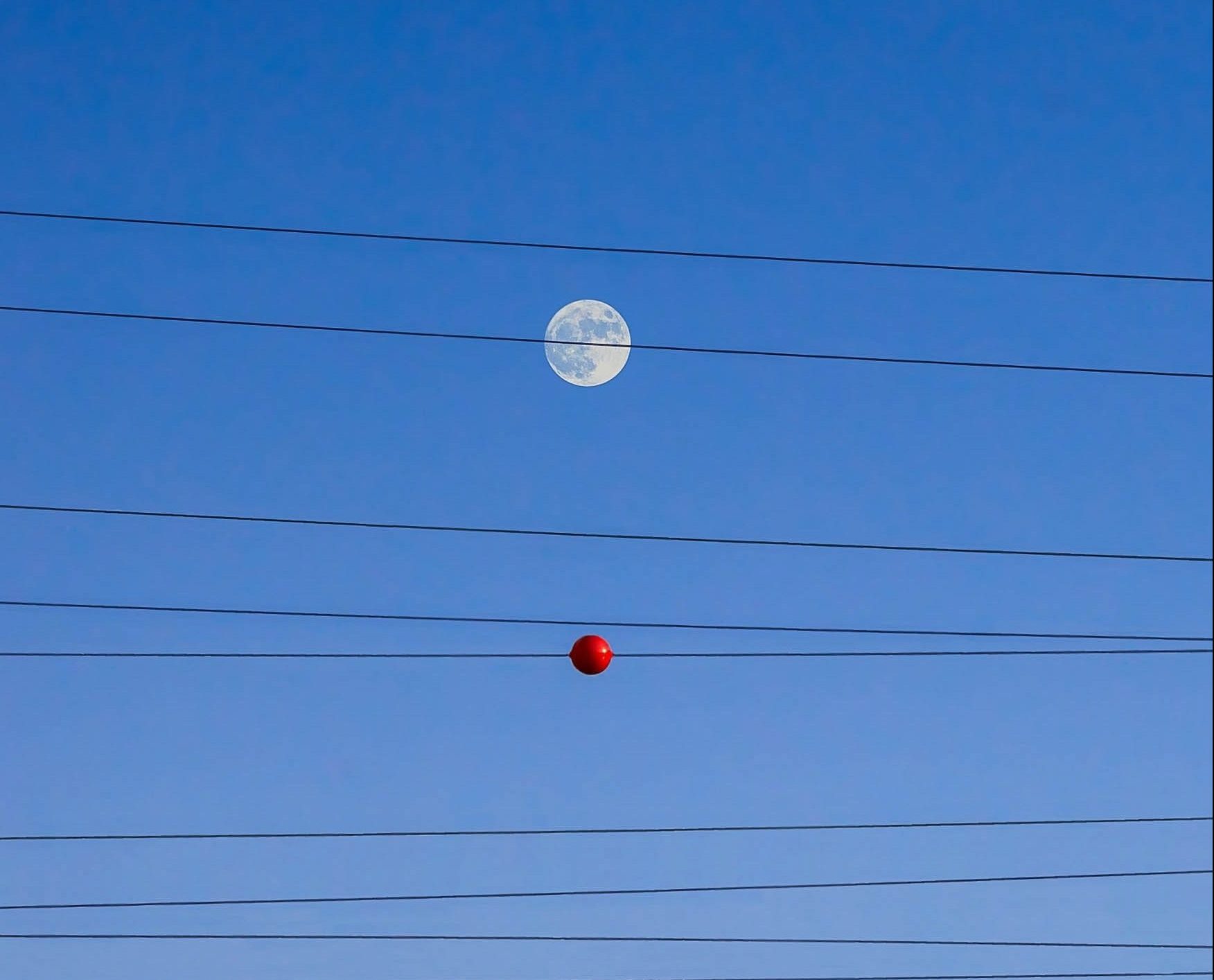
Utilities are stringing thousands of miles of new 765 kV line across the country. Data centers, AI processing hubs, and EV charging are driving demand at a pace nobody planned the grid around, and these lines are quickly becoming its backbone.
Those spans have to be visible from the air. This article covers four markers built for that job, and what separates one that lasts from one that fades in three seasons.
The problem with an unmarked span
Wires don’t show up on aeronautical charts. Below a few hundred feet, a pilot has no reliable way to know a span is there unless somebody marked it.
That’s a problem in exactly the places 765 kV lines tend to go: wide rivers, deep valleys, open country with nothing to judge distance against. Helicopters, ag planes, medical transports, and firefighting crews all work at those altitudes, often in bad light or smoke. One unmarked span is enough.
Utilities use a few names for the fix. Overhead wire markers, aerial markerballs, aerial line markers, transmission line markers. Same idea in each case, and it’s cheap insurance next to what a wire strike costs.
The cost side is documented. Between 1994 and 2018, wire strikes caused 214 accidents and killed 124 people, according to NTSB accident reports compiled by researchers at the University of Maryland and Georgia Tech. Roughly one in three of the civil helicopter strikes in that data was fatal.
They give pilots something to see
Bright color and deliberate spacing turn an invisible wire into an obvious hazard. That matters most at low elevation, on river crossings, and near airport approaches. In farm country a marker may be the only warning a crop duster gets before banking across a field.
They keep you inside FAA guidance
FAA Advisory Circular AC 70/7460-1M sets out how power lines that interfere with air navigation should be marked:
- Size. Typically 36 inches in diameter for transmission lines, distinctively shaped (spherical or cylindrical), and visible from at least 4,000 feet.
- Color. International orange, white, and yellow, alternating for best visibility.
- Spacing. Roughly 200 feet apart along the wire, tightening to 30 to 50 feet in critical areas.
- Placement. On the highest wire, or at equal height where alternate wires are used.
Not every marker on the market actually meets these. Buy from a supplier who can show you the compliance, not just claim it.
They protect the line itself
A downed 765 kV line doesn’t stay a local problem. It pulls regional grids around, triggers emergency maintenance, and eventually shows up in what customers pay. Markers are one of the least expensive pieces of protection on a transmission project.
What separates a good marker ball from a cheap one
Heat tolerance
High-efficiency lines run hot. Conductors under heavy load put out enough thermal stress to warp or fade a low-grade plastic marker inside a few seasons. Aluminum and ABS hold their shape, their color, and their structure through it. In desert heat and wildfire country that difference shows up as replacement cycles you never have to schedule.
Weight
Every extra pound on a live line is a risk to the crew mounting it. P&R Tech builds with high-strength aluminum and weather-resistant ABS so markers go up safely by helicopter, drone, hot stick, or live line tool. Lighter markers also pull less on the conductor, which matters on long spans and river crossings.
Corrosion resistance
Rain, salt spray, ice, wind, UV. Cheap markers are made with subpar material and they show it fast, chalking and cracking within a couple of years. UV-stabilized polymers and marine-grade aluminum don’t. Coastal, alpine, or industrial, they stay visible.
FAA compliance
Every P&R Tech marker is built to meet or exceed AC 70/7460-1M, including diameter, spacing, color, and day/night contrast. If your line crosses navigable airspace near an airport, a river, farmland, or an emergency landing route, that’s the standard you’re being measured against.
The four markers
1. SpanLite™ Self-Illuminated Power Line Marker
Lighted aluminum marker running two steady red LEDs off patented technology. No batteries, no wiring, just a line carrying at least 40 A, and it works up to 2,000 A. Meets FAA and ICAO standards for day and night marking. This is the one for fog, low light, and busy air corridors.
2. SpanGuard™ AL High Temperature Marker
Aluminum, rated to 250° C (482° F) and 500 kV. Built for the lines where conductor temperature actually becomes a design constraint.
3. SpanGuard™ ABS Standard Power Line Marker
The ABS marker engineered specifically for 115 kV to 345 kV lines.
4. SpanGuard™ EHV 115 kV Marker
Written into a lot of utility buying standards, and for good reason. Durable ABS, highly visible, UV stable, and good for years of service on lines up to 115 kV.
Need a different size, color, or material? We build the full range. We also make bird diverters and powerline monitoring equipment.
Buying for longevity
The grid is being asked to carry more than it was built for, and the answer utilities keep landing on is long-distance, high-capacity 765 kV line. That build-out is moving fast, which means marking decisions are getting made fast too.
If you’re specifying markers for one of those projects, buy the ones that will still be doing their job for years. We’ve been making them for utilities since 1960.