
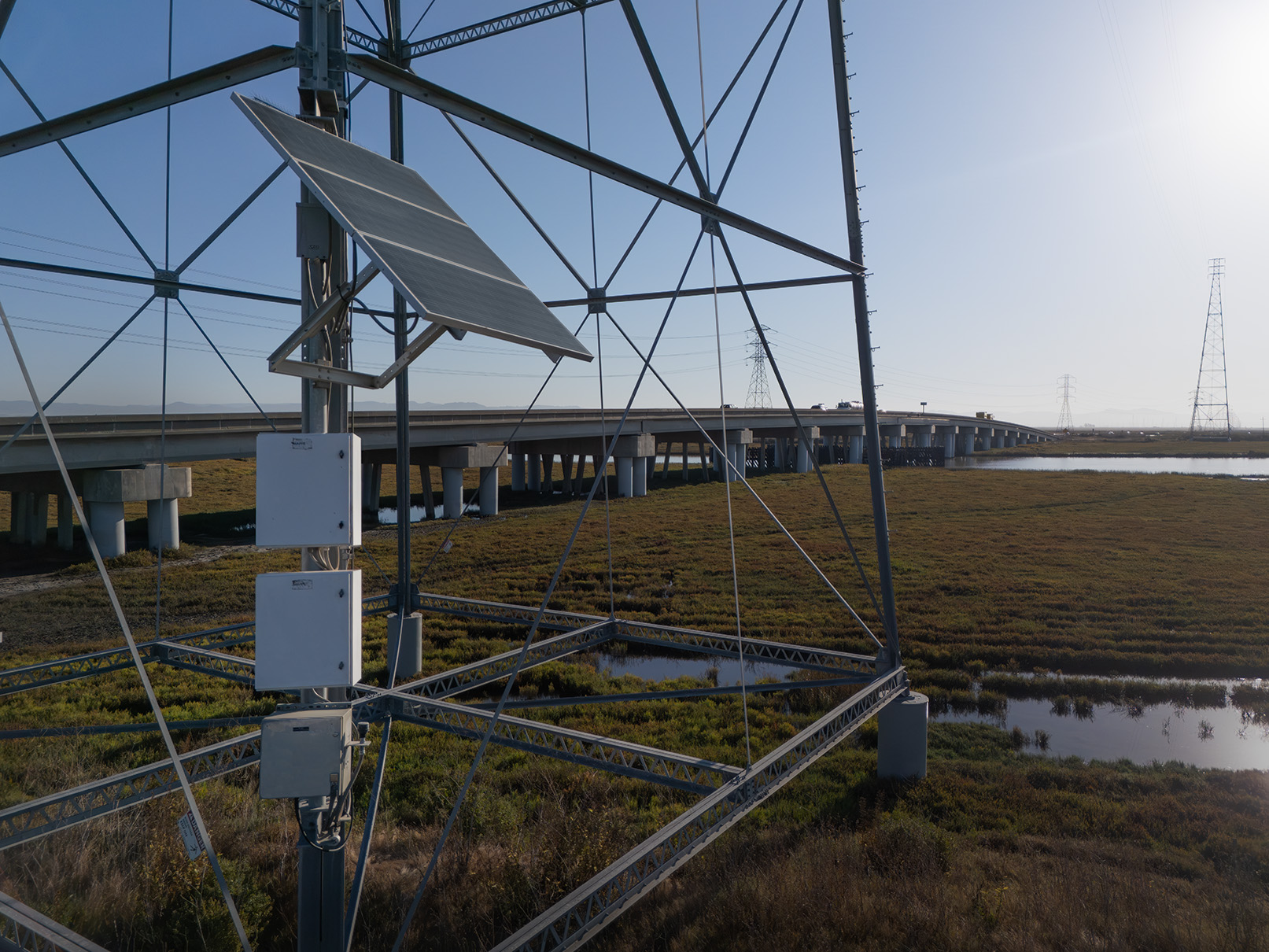
Solar aircraft warning lights are obstruction lights that run on a solar panel and battery instead of a power line. They let utilities light transmission towers and other tall structures without trenching in power or building a line extension. On remote sites, that usually makes them cheaper and faster to put up. P&R Tech’s SunPOWR solar obstruction lights cover the most common types of tower lighting.
What are aircraft warning lights?
Aircraft warning lights, also called aviation obstruction lights, are the red and white lights on tall structures that help pilots see them. Under FAA Advisory Circular 70/7460-1N, structures over 200 feet generally have to be marked or lit, and the FAA can ask for the same on shorter structures because of where they stand.
Most tower lighting comes down to height. Towers 150 feet or shorter generally carry steady red lights, and taller ones carry at least one flashing red beacon. Those rules apply to the towers that hold up transmission lines as well as to cell tower lights and radio tower lights.
How does solar power for tower obstruction lighting work?
A panel charges a battery during the day, and the battery runs the lights at night and through cloudy stretches. Low-power LEDs keep that setup small. The FAA says an LED L-810 obstruction light can use about a tenth of the power of an incandescent one, so the panel and battery can fit on a pole or tower.
Which SunPOWR lights can utilities choose from?
- SunPOWR RTO Single & Dual: steady red lights for shorter towers and poles, with an infrared option for night vision.
- SunPOWR L-864: a flashing red solar beacon light for taller towers and wind turbines, also with an infrared option.
- SunPOWR L-864/865: a dual beacon with flashing white by day and red at night, for structures that need lighting around the clock.
Where grid power is already close, P&R Tech also sells hard-wired LED obstruction lights.
Why are solar aircraft warning lights so convenient for utilities?
Most of the convenience, and much of the savings, comes from work a crew no longer has to do. There’s no trench to dig or cable to run, and without a line extension there are no new poles, right-of-way or permits to wait on. Nobody has to put a step-down transformer on a high-voltage line to feed a few LEDs, and with no connection to the circuit, there’s no tie-in for crews to schedule around. Lighting a tower becomes a mounting job instead of a construction project.
The lights can run as soon as they’re mounted, which helps on new lines where towers go up long before the line is energized. They also run off their own battery, so a storm or fault that knocks out the local distribution line doesn’t take the tower lights down with it, and one outage doesn’t turn into a lighting failure to report to the FAA.
Sealed batteries never need watering, so upkeep takes little crew time. Wireless monitoring, available on every SunPOWR system, reports on the lights from a central station. Without a monitor, the FAA asks for a visual check every 24 hours, and it recommends one for structures that are hard to reach. On a remote line, that saves a drive out to each tower to see whether the lights are on.
Why are SunPOWR solar obstruction lights cost effective?
The biggest saving is the power line you don’t have to build. The FAA’s engineering brief on solar obstruction lighting says a solar system can often be designed for half the cost of a commercial power extension, especially once a tower is more than half a mile from existing lines. New lines also bring permitting. One Nevada utility waited nearly two years for a permit on a distribution line of just eight poles.
- Low-power LEDs need smaller batteries and panels.
- The lights have no utility service or electric bill.
- Crews stop relamping. P&R notes that some utilities have replaced as many as 300 incandescent bulbs a year on obstruction lights.
What do solar obstruction lights do for the power grid?
- Skipping a line extension means no new line to patrol and repair after storms.
- A tower without a low-voltage feed has one less wire nearby for a low-flying pilot to miss.
- New transmission can run through remote country, where it connects solar and wind projects to the rest of the grid, without waiting on separate power for its tower lights.
- Well-lit structures help protect the grid as well as pilots. When a small plane hit a transmission tower in Gaithersburg, Maryland, in 2022, about 120,000 customers lost power. The report didn’t tie that crash to lighting.
Tower lights cover the structures. For the wires between them, P&R Tech offers power line markers, including SpanLite lighted markers that draw their power from the line itself.
How reliable are solar aircraft warning lights?
The FAA’s brief says a properly designed solar system “will be very reliable” and need little maintenance. P&R Tech calculates each SunPOWR system for the light type and location, so a panel in Seattle may be twice the size of one in Arizona.
SunPOWR LEDs are rated for 15 years, and the system has no moving parts. On the 125-mile, 500 kV Ten West Link in Arizona and California, P&R Tech helped provide solar obstruction lighting systems with remote monitoring along a route with long stretches of open desert.
To talk through a tower or a whole line, see our solar FAA obstruction lights or contact P&R Tech.
Frequently asked questions
The FAA’s standards apply to the light itself, whatever powers it. A solar system has to use fixtures that meet the FAA’s specification for each light type, the same as a hard-wired one.
Often, especially when the tower is more than about half a mile from commercial power. The FAA says a solar system can often cost half as much as a power line extension.
The FAA’s guidance on solar obstruction lighting calls for at least seven days of battery power in winter conditions. Actual run time depends on how a system is sized for its site.
Yes. L-864 LED beacons come in low-voltage DC versions, which suit solar power because they don’t need an inverter.
Very little. Panels may need cleaning at snowy or dusty sites, and sealed batteries are the main part to replace over time. The FAA expects a well-designed system to run at least five years, and solar panels can keep producing for 25 years or longer.